



September 28th, 2026
Kundalini vs. Spiritual Awakening Explained
For anyone navigating the modern landscape of personal growth, the word "awakening" is everywhere. Yet, as many seekers discover, not all awakenings feel or look the same. Two of the most frequently confused experiences are a spiritual awakening and a Kundalini awakening.
While both permanently alter how you perceive reality, confusing the two can leave a person feeling deeply disoriented. Understanding their unique mechanics, symptoms, and integration paths is essential for navigating the journey safely.
What is a Spiritual Awakening?
A spiritual awakening is a profound shift in consciousness. It is the moment the "ego-self" cracks open, allowing you to realize that you are not just your thoughts, your job, or your past conditioning. You transition from living in a state of separation to experiencing a deep sense of interconnectedness with the world around you.
• The Catalyst: It can be triggered by almost anything—a profound loss, a major life transition, a walk in nature, or a slow, steady realization through mindfulness practices.
• The Experience: It is primarily psychological, emotional, and existential. You begin to question your values, look for deeper meaning, and feel a sudden detachment from purely material pursuits.
• The Analogy: Imagine waking up from a dream and realizing you are the reader of the book, not just a character trapped in the plot.
What is a Kundalini Awakening?
A Kundalini awakening is a specific, bio-energetic event. In Eastern traditions, Kundalini is described as a concentrated form of life-force energy (Shakti) that lies dormant at the base of the spine. When it awakens, this energy forces its way upward through the central energy channel (Sushumna Nadi), piercing and clearing the chakras.
• The Catalyst: Often triggered by intentional, intense spiritual practices (like breathwork, Kriya Yoga, or deep meditation), but it can also be accidentally sparked by extreme physical trauma or intense, prolonged stress.
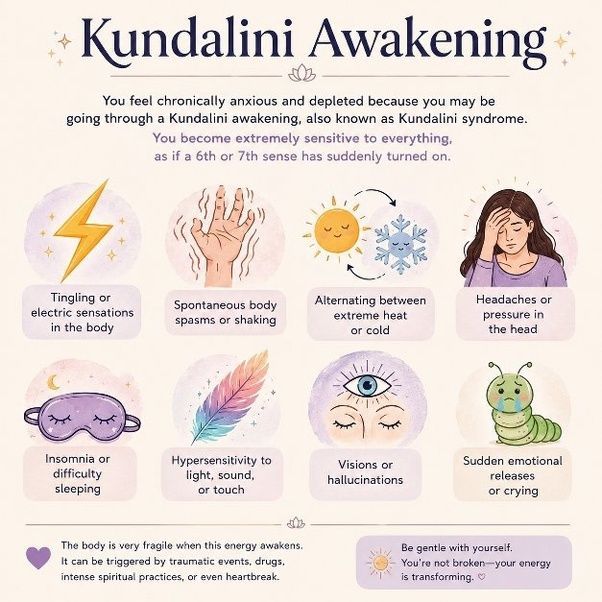
• The Experience: It is highly visceral and physiological. Seekers often report feeling literal electricity, intense heat or cold, involuntary body movements (kriyas), or overwhelming rushes of emotion.
• The Analogy: Imagine plugging a standard household appliance directly into a high-voltage city power grid. The sudden surge of raw energy forces an immediate upgrade of the entire system.
How They Intersect
These two experiences are not mutually exclusive; they are deeply intertwined facets of human evolution.
A spiritual awakening often expands your awareness first, preparing your mind and ego to handle the intense physical energy of a Kundalini rising later. Conversely, a sudden Kundalini awakening will forcefully shatter your ego, instantly plunging you into a profound spiritual awakening whether you feel ready for it or not.
Guidance for the Journey: Integration and Grounding
Because a Kundalini awakening involves raw biological and energetic shifts, it requires a different level of care than a traditional spiritual shift.
• For Spiritual Awakenings: Focus on cognitive integration. Journaling, finding a like-minded community, processing emotional shifts, and restructuring your life to match your new values are highly effective.
• For Kundalini Awakenings: Focus on somatic grounding. When energy loops too high in the body, it can cause anxiety, insomnia, or disorientation. Grounding practices include eating heavy root vegetables, walking barefoot on the earth, halting intense breathwork, and engaging in gentle body movement like Yin Yoga.
Conclusion: Honoring Your Unique Path
Whether your awakening feels like a quiet dawn breaking across your mind or a lightning bolt firing up your spine, both paths lead toward the same destination: liberation, authenticity, and alignment with truth. By recognizing the map of the territory you are walking, you can move from a place of fear or confusion into one of profound reverence for your body’s innate wisdom.